

In this difficult year that our Kurdish nation is...
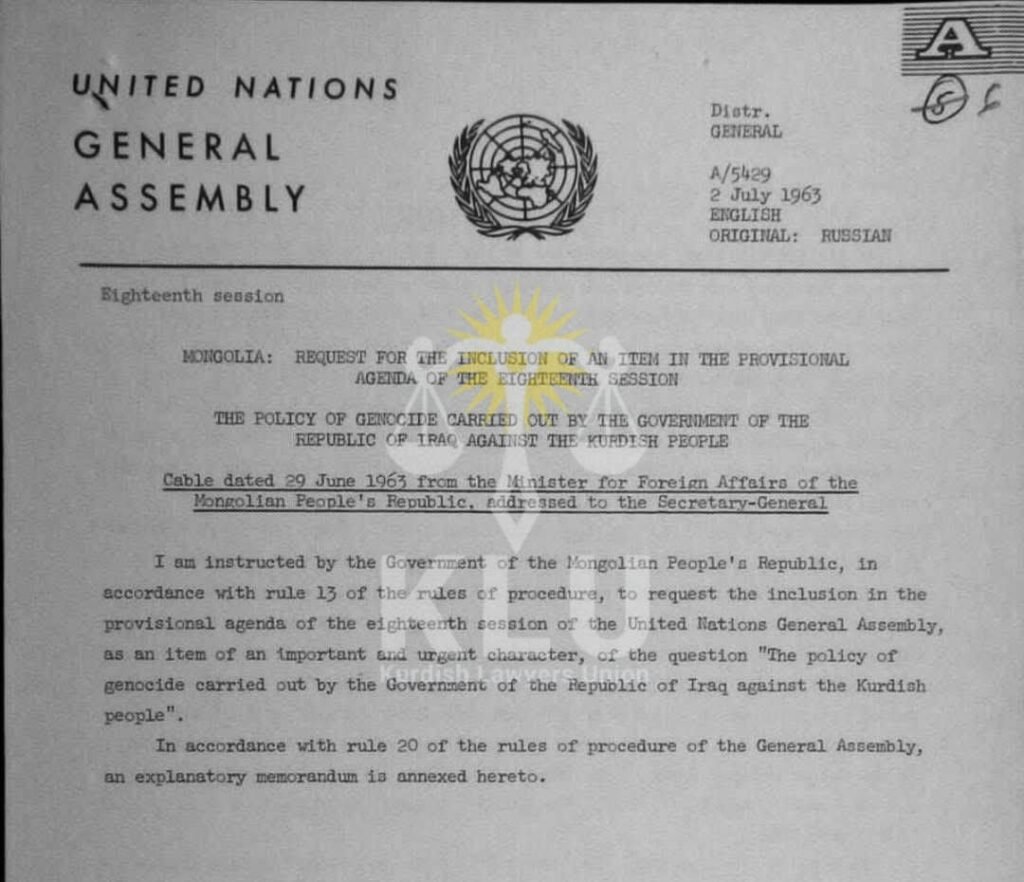
UNITED NATIONS
GENERAL ASSEMBLY
Distr.: GENERAL
A/5429
2 July 1963
ENGLISH
ORIGINAL: RUSSIAN
Eighteenth session
MONGOLIA: REQUEST FOR THE INCLUSION OF AN ITEM IN THE PROVISIONAL AGENDA OF THE EIGHTEENTH SESSION
THE POLICY OF GENOCIDE CARRIED OUT BY THE GOVERNMENT OF THE REPUBLIC OF IRAQ AGAINST THE KURDISH PEOPLE
Cable dated 29 June 1963 from the Minister for Foreign Affairs of the Mongolian People’s Republic, addressed to the Secretary-General
I am instructed by the Government of the Mongolian People’s Republic, in accordance with rule 13 of the rules of procedure, to request the inclusion in the provisional agenda of the eighteenth session of the United Nations General Assembly, as an item of an important and urgent character, of the question “The policy of genocide carried out by the Government of the Republic of Iraq against the Kurdish people”.
In accordance with rule 20 of the rules of procedure of the General Assembly, an explanatory memorandum is annexed hereto.
A/5429
English
Page 2
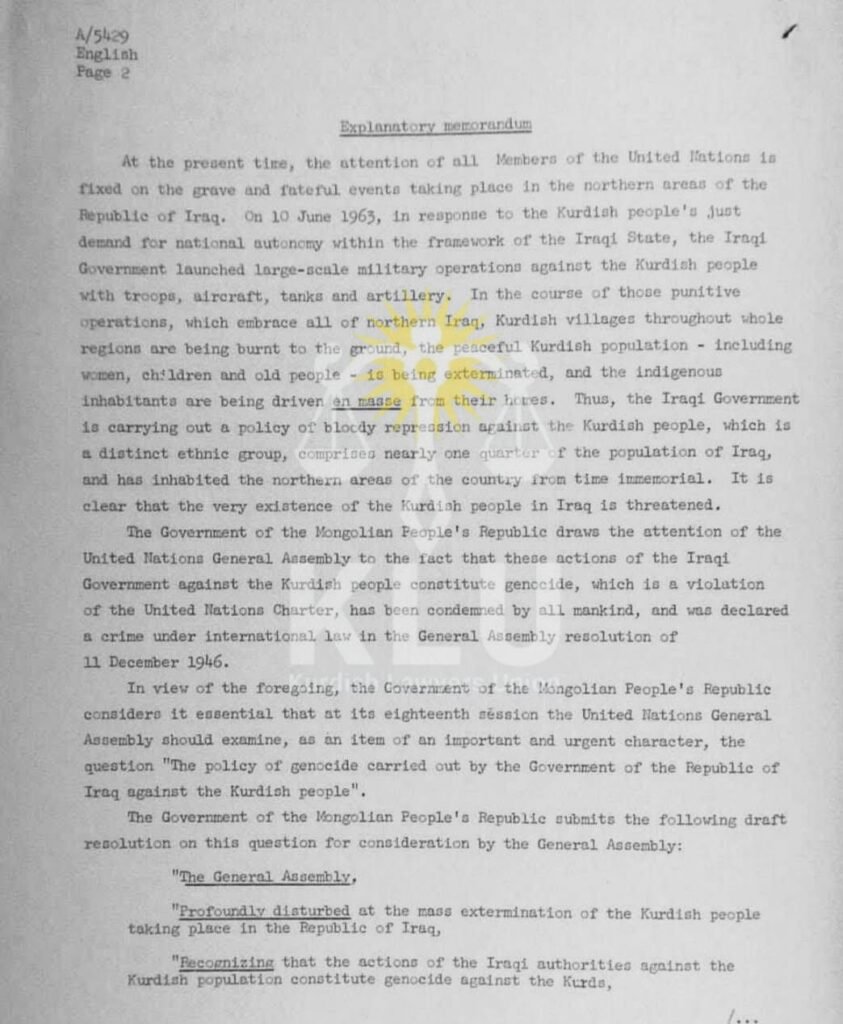
Explanatory Memorandum
At the present time, the attention of all Members of the United Nations is fixed on the grave and fateful events taking place in the northern areas of the Republic of Iraq. On 10 June 1963, in response to the Kurdish people’s just demand for national autonomy within the framework of the Iraqi State, the Iraqi Government launched large-scale military operations against the Kurdish people with troops, aircraft, tanks and artillery. In the course of those punitive operations, which embrace all of northern Iraq, Kurdish villages throughout whole regions are being burnt to the ground, the peaceful Kurdish population — including women, children and old people — is being exterminated, and the indigenous inhabitants are being driven en masse from their homes.
Thus, the Iraqi Government is carrying out a policy of bloody repression against the Kurdish people, which is a distinct ethnic group, comprises nearly one quarter of the population of Iraq, and has inhabited the northern areas of the country from time immemorial. It is clear that the very existence of the Kurdish people in Iraq is threatened.
The Government of the Mongolian People’s Republic draws the attention of the United Nations General Assembly to the fact that these actions of the Iraqi Government against the Kurdish people constitute genocide, which is a violation of the United Nations Charter, has been condemned by all mankind, and was declared a crime under international law in the General Assembly resolution of 11 December 1946.
In view of the foregoing, the Government of the Mongolian People’s Republic considers it essential that at its eighteenth session the United Nations General Assembly should examine, as an item of an important and urgent character, the question “The policy of genocide carried out by the Government of the Republic of Iraq against the Kurdish people”.
The Government of the Mongolian People’s Republic submits the following draft resolution on this question for consideration by the General Assembly:
“The General Assembly,
“Profoundly disturbed at the mass extermination of the Kurdish people taking place in the Republic of Iraq,
“Recognizing that the actions of the Iraqi authorities against the Kurdish population constitute genocide against the Kurds,
A/5429
English
Page 3
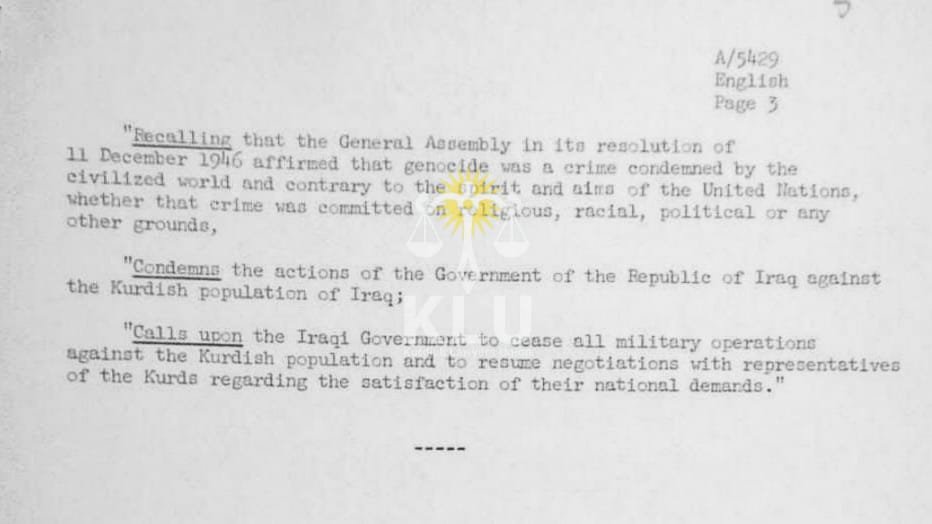
“Recalling that the General Assembly in its resolution of 11 December 1946 affirmed that genocide was a crime condemned by the civilized world and contrary to the spirit and aims of the United Nations, whether that crime was committed on religious, racial, political or any other grounds,
“Condemns the actions of the Government of the Republic of Iraq against the Kurdish population of Iraq;
“Calls upon the Iraqi Government to cease all military operations against the Kurdish population and to resume negotiations with representatives of the Kurds regarding the satisfaction of their national demands.”
Source: United Nations Archives.

UNITED NATIONSGENERAL ASSEMBLY Distr.: GENERALA/54292 July 1963ENGLISHORIGINAL: RUSSIAN Eighteenth...
UNITED NATIONSSECURITY COUNCILDistr.GENERALS/53459 July 1963ENGLISHORIGINAL: RUSSIANLETTER DATED 9 JULY...
Al-Ra'i Prison is one of the most prominent irregular...