

In this difficult year that our Kurdish nation is...
AL-RA'I PRISON: A COMPREHENSIVE LEGAL CHARACTERIZATION OF THE DETENTION SYSTEM AND SYSTEMATIC VIOLATIONS
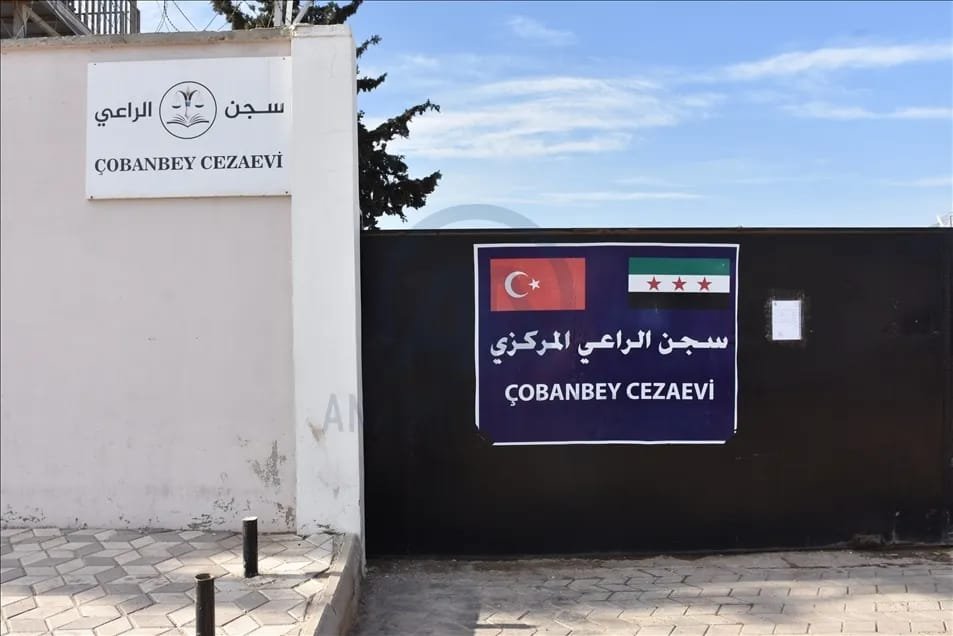
Al-Ra’i Prison is one of the most prominent irregular detention facilities, located in the town of al-Ra’i in the northeastern part of Aleppo Governorate, near the Syrian-Turkish border. The prison is administered by what is referred to as the “Military Police” of Turkish-backed armed factions, operating within a security apparatus under the effective and direct supervision of Turkish intelligence services. This facility is used primarily for the detention of civilians, particularly Kurdish citizens from the Afrin region, since those factions seized control of the area in March 2018.
Consistent testimonies and reliable sources indicate that al-Ra’i Prison constitutes a central link in a systematic pattern of arbitrary detention and enforced disappearance, whereby civilians are held without judicial orders, without clearly formulated charges, and without being brought before independent courts, while being fully denied the fundamental guarantees of a fair trial. In 2024 alone, hundreds of detention cases were documented in Afrin, including children and women, with hundreds of detainees continuing to be subjected to enforced disappearance, and large numbers transferred to al-Ra’i Prison and other detention facilities controlled by Turkish-backed factions under direct Turkish security oversight.
From a structural standpoint, al-Ra’i Prison does not constitute a lawful or regular detention facility by international standards. It is composed of former service buildings — most likely a school or government office — based on testimonies obtained by the Monitoring, Documentation and Archiving Committee from survivors of this prison, who reported that upon entry and exit they were blindfolded and held in basement floors, with the length of the corridors strongly suggesting to them that the building had been a school forcibly converted into a place of detention without any legal or humanitarian adaptation. These facilities operate in an environment of severe overcrowding, with dozens of detainees held in cramped rooms wholly inadequate to minimum space requirements, forced to sleep on bare floors amid acute shortages of blankets and clothing and a complete absence of sanitary supplies, particularly during winter months. Conditions are further aggravated in solitary confinement cells, used as a punitive measure or during interrogation, where detainees are held in extremely confined, dark, and poorly ventilated spaces for periods ranging from days to weeks — a pattern of prolonged solitary confinement that is prohibited under international law and classified as a form of torture or cruel and inhuman treatment. The prison facilities also suffer from a near-total absence of ventilation and lighting, elevated humidity levels particularly in the basement floors, and a complete lack of basic healthcare, with no qualified medical personnel or resident physicians, injuries from torture left untreated, and malnutrition widespread due to the inadequacy and insufficiency of food. Wholly primitive sanitary facilities compel large numbers of detainees to share a single toilet with no privacy, in flagrant violation of human dignity.
Testimonies of former detainees confirm the existence of rooms designated for interrogation and torture within the prison, generally segregated from the communal cells. Documented methods of torture include severe beatings, suspension, electric shocks, prolonged restraint, deprivation of sleep and food, and confinement in cramped and damp spaces. A number of survivors have compared al-Ra’i Prison to Saydnaya Prison in terms of the level of brutality and the psychological collapse experienced by detainees, with entry into the facility widely regarded as an end to any semblance of normal life.
Detainees are systematically denied any contact with the outside world. Visits are entirely prohibited or extremely rare, no legal counsel or representation is permitted, and families are in many cases never informed of the place of detention. Communication with families is typically mediated through financial extortion and ransom demands in exchange for information or promises of release. Recent and credible testimonies further confirm that a number of women from the Afrin region remain abducted and detained in al-Ra’i Prison as of the date of preparation of this report, with the Kurdish Bar Association maintaining their personal data and documentation. This situation necessitates their immediate and unconditional release, the guarantee of their physical and psychological safety, and the accountability of all those responsible for their continued arbitrary detention.
Al-Ra’i Prison does not function solely as a local detention site; it forms an integral part of a cross-border detention system that begins with arrest in Afrin, proceeds through Azaz Prison and then al-Ra’i, and extends to unlawful transfer into Turkish territory followed by subsequent return. Survivors have documented their detention and interrogation inside Turkey conducted exclusively in the Turkish language, the imprisonment of some detainees in Turkish prisons in the provinces of Kilis and Hatay, and sham trials that lacked the most basic standards of justice, resulting in harsh sentences on broad charges such as “terrorism” without evidence or effective defense, and involving financial extortion through lawyers connected to the same system.
These practices reveal a clear discriminatory dimension, particularly targeting Kurdish civilians and especially Yazidis, with documented instances of collective ethnic and religious abuse, prohibition of the Kurdish language, and attempts to forcibly impose religious conversion — acts that open the door to characterizing such conduct as crimes of persecution in addition to constituting war crimes.
From the perspective of international law, the practices of detention, torture, and enforced disappearance at al-Ra’i Prison constitute grave and systematic violations of the Geneva Conventions — most notably the Fourth Geneva Convention Relative to the Protection of Civilian Persons in Time of War — the International Covenant on Civil and Political Rights, the Convention Against Torture, and the United Nations Standard Minimum Rules for the Treatment of Prisoners (the Nelson Mandela Rules). The forcible transfer of detainees across international borders and their prosecution within the territory of the occupying power further constitutes a manifest breach of Articles 49, 64, and 66 of the Fourth Geneva Convention and a direct violation of the right to a fair trial.
Turkey bears direct international legal responsibility for these violations by virtue of its involvement and complicity, its exercise of effective control over the territory, its supervision of the armed factions, and the participation of its security agencies in the processes of arrest, interrogation, transfer, detention, and prosecution. Al-Ra’i Prison cannot be dissociated from a broader policy that employs arbitrary detention, forcible transfer, and sham trials as instruments for reshaping the demographic reality of Afrin. The violations perpetrated at al-Ra’i Prison accordingly represent a compound pattern of grave crimes rising to the level of international crimes, necessitating an independent international investigation and comprehensive legal accountability for all those responsible, including the entities that exercise effective control and direct oversight over the detention system.
Kurdish Lawyers‘ Union
Monitoring, Documentation and Archiving Committee
Bonn, Germany
25/2/ 2026
Most recent

UNITED NATIONSGENERAL ASSEMBLY Distr.: GENERALA/54292 July 1963ENGLISHORIGINAL: RUSSIAN Eighteenth...
UNITED NATIONSSECURITY COUNCILDistr.GENERALS/53459 July 1963ENGLISHORIGINAL: RUSSIANLETTER DATED 9 JULY...
Al-Ra'i Prison is one of the most prominent irregular...