
In this difficult year that our Kurdish nation is...
The results of field monitoring conducted by the Kurdish Lawyers Union reveal concerning indicators of continued patterns of exclusion, weak institutional efficiency, and growing interference in personal and professional freedoms, negatively affecting public trust in state institutions.
This report is based on consistent testimonies and statements from employees, lawyers, and visitors to official departments, documented during the recent period, with names withheld for confidentiality.
The monitoring results reveal dysfunction in the general administrative landscape:
The Concept of “We Liberated You” and Its Impact on the Administrative Reality
Testimonies indicate the presence of an implicit discourse based on the idea of “we liberated you,” along with manifestations of favoritism and condescension or special treatment based on regional affiliation to Idlib. Vehicles bearing Idlib license plates are reportedly given priority passage by everyone, reminiscent of the security vehicles of the former regime.
Cases were documented in certain official departments, including the Civil Registry Office, where employees were reportedly appointed without possessing any qualifications.
In one incident, a citizen stated verbatim:
“I went to the Civil Registry to register my children. An employee took the family booklet from me, then handed it to another employee to do the writing because he did not know what to do. When I asked about the matter, I was told: ‘He is from Idlib. He does not know how to write, but he is an employee.’”
It was also reported that a newly created administrative position in the Aleppo Palace of Justice, under the title “Head of the Justice Palace,” is held by Sheikh Abu Jaber, who is described as the ultimate authority within the Aleppo Palace of Justice. He is not legally trained but holds a Sharia course certificate from Idlib and exercises broad powers within the Justice Palace despite lacking specialized legal qualifications.
According to testimonies, in every department there is a sheikh who acts as the ultimate authority—individuals with religious rather than legal backgrounds who assume influential decision-making roles.
These accounts reflect, according to witnesses, a pattern of empowerment based on loyalty and affiliation rather than competence and merit.
Exclusion of Local Competencies
Consistent testimonies from intellectuals, academics, and local employees report marginalization and exclusion from decision-making and public administration positions despite possessing accumulated experience and academic qualifications.
These testimonies confirm that current appointment mechanisms do not rely on transparent standards, leading to the displacement of qualified local professionals and their replacement by individuals lacking the required expertise. Several witnesses reiterated that the current reality has not introduced a fundamental change in the structure of administration compared to the previous phase, particularly regarding the absence of genuine participation by independent professionals.
Restrictions on Personal and Professional Freedoms
At a time when the country is experiencing deteriorating economic and living conditions and serious challenges in securing essential services, several decisions and measures have been observed that are considered distant from urgent priorities and that affect personal and professional freedoms.
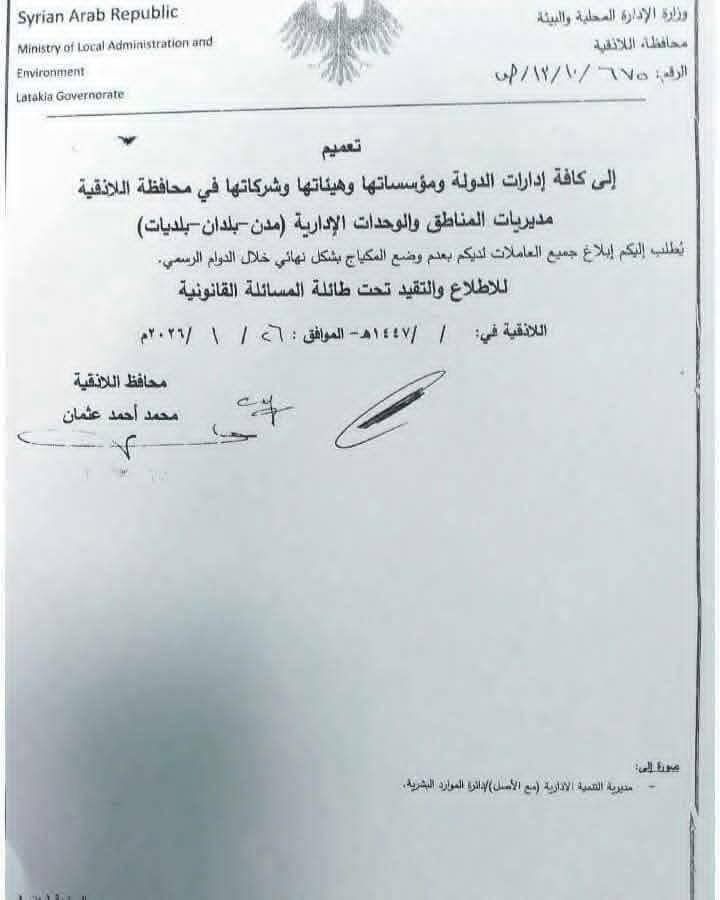
The Governor of Latakia issued Circular No. (12/10/675/S) dated January 26, 2026, addressed to all state administrations and institutions, requiring that all female employees refrain entirely from wearing makeup during official working hours, under penalty of legal accountability.
Similar decisions were reportedly issued in other bodies, including the Aleppo Bar Association, requesting female lawyers not to adorn themselves, in addition to documented cases of restrictions in some official departments described as direct interference in the sphere of personal freedom without clear legal justification.
These circulars constitute a restriction on constitutionally guaranteed personal freedoms and raise concerns regarding violation of the principle of legality due to the absence of an explicit legislative basis, in addition to contradicting the principle of equality and the Convention on the Elimination of All Forms of Discrimination Against Women (CEDAW).
Disbarment Decisions and Union Measures
On October 29, 2025, the Damascus Countryside Branch of the Bar Association issued an immediately enforceable administrative decision, in its guardianship capacity, to strike ten lawyers from the roll and prohibit them from practicing the profession, based on what was described as failure to adhere to good morals that inspire the trust and respect required by the profession. It was noted that the “Truth and Justice Committee” formed by the branch recommended automatic disbarment due to the loss of more than one condition required to practice the profession.
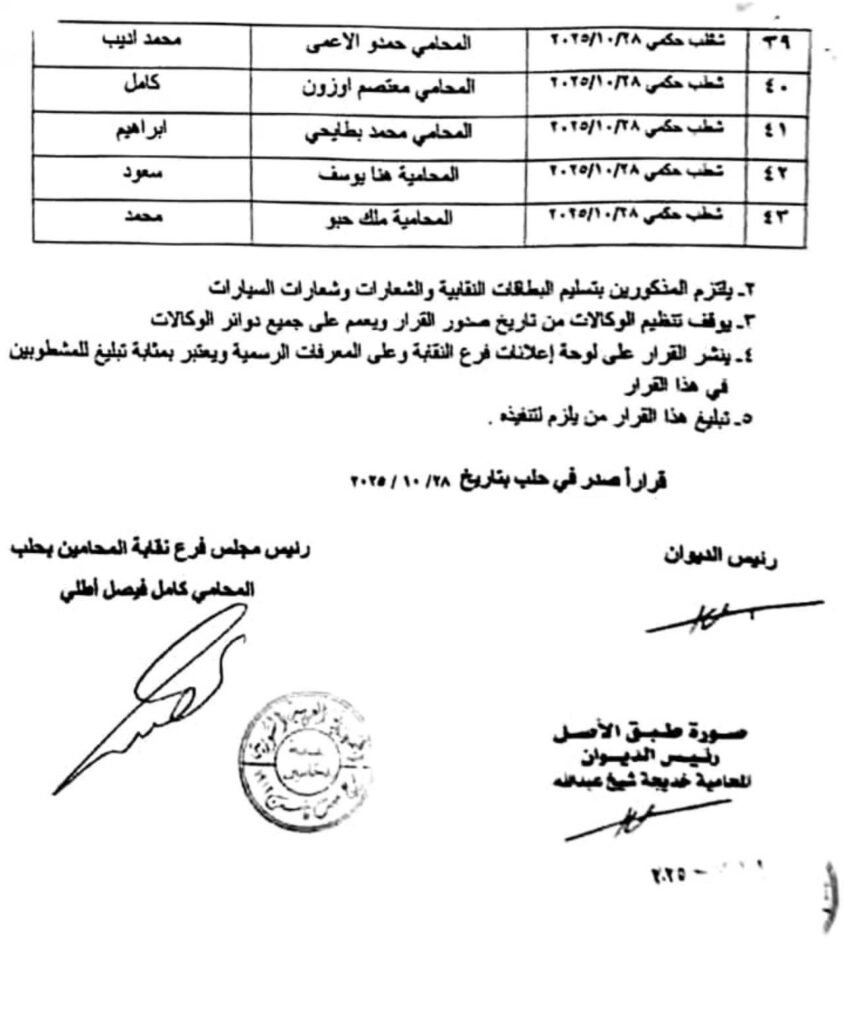
Similarly, the Aleppo Branch Council of the Bar Association issued Decision No. (2335) dated October 28, 2025, striking 43 lawyers automatically from the register. The disbarment decision was issued as an administrative guardianship measure rather than a judicial disciplinary ruling, rendering it immediately enforceable, and appeals before the Bar Council do not suspend execution.
Sources indicate that a retaliatory and exclusionary mentality, alongside new centers of influence, currently dominate, amid fears of the misuse of administrative powers in a manner affecting the independence of union work and the right of defense, constituting an abuse of authority.
Threats and the Professional Climate within the Legal Community
The report documented that several members of a forum known as the “Lawyers’ Forum in Syria” issued direct threats against Kurdish lawyers on social media platforms, using threatening, inciting, and insulting language, violating all ethical standards and adopting an intimidating approach toward those who disagree with them, including explicit statements affecting personal safety.
It was also reported that some members exploited their influence and threatened to take measures or detain lawyers who opposed their views within the Palace of Justice, behavior inconsistent with professional values and the ethics of the legal profession.
Several lawyers, particularly Kurdish lawyers, expressed reluctance to file complaints with the Public Prosecution or the Bar Association due to growing concerns about declining guarantees of professional immunity and the perception that certain authorities have begun acting simultaneously as both adversary and judge, thereby undermining confidence in the effectiveness of legal remedies.
Key Indicators Identified
The findings of this monitoring indicate:
- Weak standards of competence and transparency in administrative appointments.
- Continued patterns of exclusion and marginalization of qualified professionals under broad justifications.
- Growing restrictions on personal freedoms within public institutions.
- Misuse of union and administrative powers affecting professional independence and institutional neutrality.
- A decline in the sense of professional security among a number of lawyers.
These indicators reflect a regression in the rule of law and its implications for the independence of union and judicial institutions and the protection of fundamental freedoms in accordance with relevant national and international standards.
Kurdish Lawyers Union
Monitoring, Documentation and Archiving Committee
Bonn – Germany
17 February 2026
UNITED NATIONSGENERAL ASSEMBLY Distr.: GENERALA/54292 July 1963ENGLISHORIGINAL: RUSSIAN Eighteenth...
UNITED NATIONSSECURITY COUNCILDistr.GENERALS/53459 July 1963ENGLISHORIGINAL: RUSSIANLETTER DATED 9 JULY...
Al-Ra'i Prison is one of the most prominent irregular...