

In this difficult year that our Kurdish nation is...
Preliminary Briefing on the Findings of Field Monitoring in Afrin
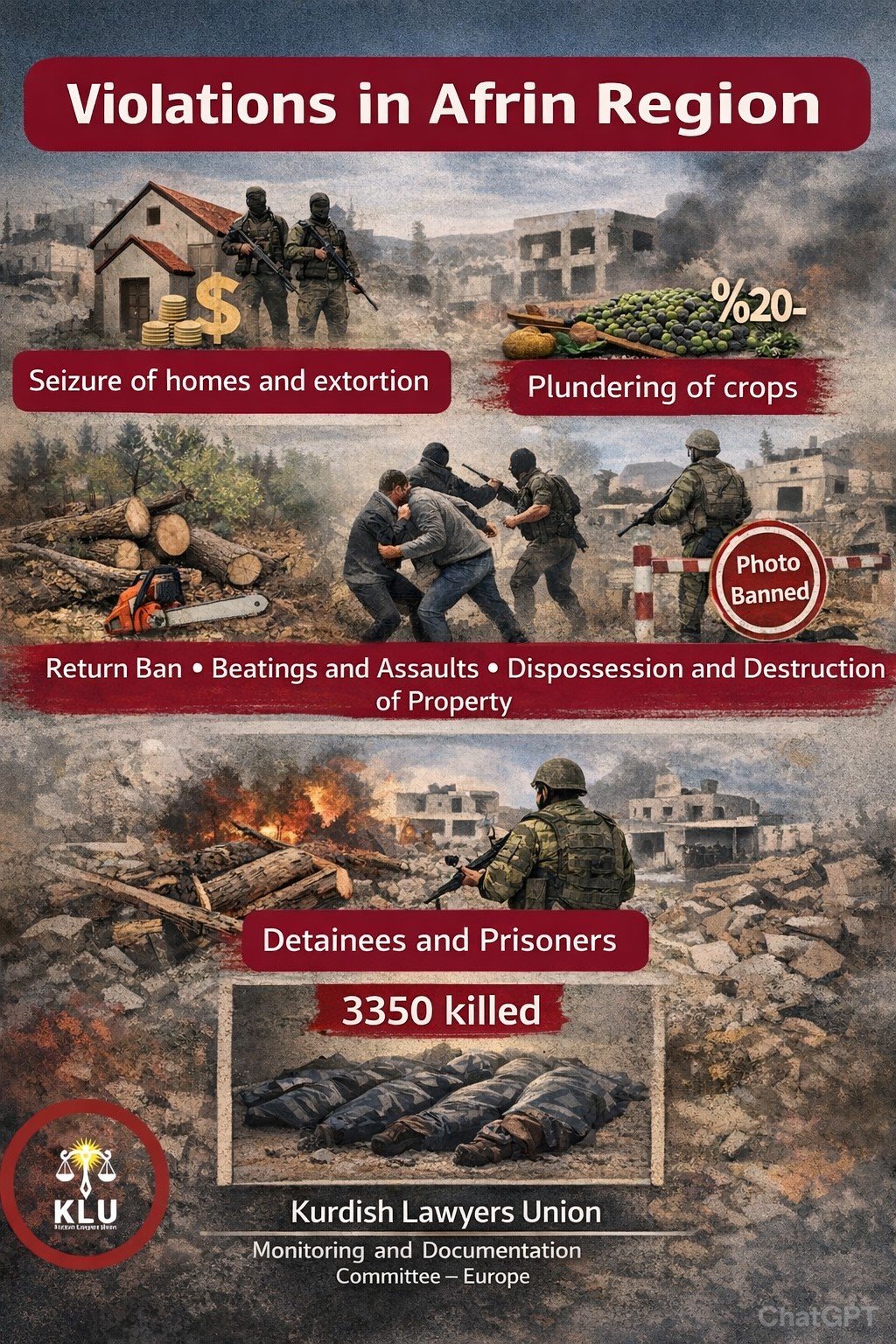
Within the framework of field monitoring and the collection of documented testimonies in the Afrin region, a series of violations and practices affecting property rights and the personal security of residents have been recorded, particularly in the subdistricts of Rajo, Bulbul, and Jandairis.
Given the prevailing security conditions and in order to ensure the safety of witnesses and affected individuals, names and identifying details are being withheld. Several individuals expressed fear of providing testimony due to concerns about retaliatory actions.
Monitoring covered a number of villages located within areas controlled by a specific armed faction. Patterns of treatment toward residents were documented as follows:
First: Seizure of Homes and Imposition of Financial Extortion
Documented cases indicate that armed elements approached civilian homeowners, claimed ownership of their properties, and ordered them to vacate.
In many instances, following pressure and coercive negotiations, forced settlements were imposed allowing the owner to remain in their home only in exchange for periodic financial payments treated as “rent,” despite the individual being the lawful owner of the property.
Such practices constitute a form of extortion and the unlawful imposition of levies outside any legitimate legal framework, representing a clear violation of legally protected property rights.
Second: Levies Imposed on Agricultural Seasons
Two main patterns of extortion related to agricultural production—particularly olive crops—were recorded:
- First case: Landowners are required to pay a financial percentage that varies depending on the controlling authority in the area. Each authority sets its own rate, ranging between 15% and 25% of total production value.
- Second case: Where an individual manages property belonging to relatives (particularly in cases of absence or displacement), the imposed percentage rises to between 40% and 60% of production value.
These percentages are imposed without accounting for agricultural service costs or operational expenses.
Residents’ testimonies indicate that preserving olive trees and preventing their cutting has become a top priority under these circumstances, despite the heavy financial burdens imposed upon them.
Third: Deforestation and Encroachment on Land
Cases of woodland cutting were documented, including lands registered under the names of local families in the villages of Bilêlko, Avrazê, and Gobekê. These acts were reportedly carried out by settlers residing in those villages.
In one testimony, an affected individual stated that he drove his agricultural tractor to land belonging to his family after learning of ongoing logging operations. Upon arrival, he found individuals cutting trees. When he objected, his property rights were treated with clear contempt, and he was instructed to transport the cut firewood to them. He was told verbatim:
“Good thing you came so you can carry the wood for us.”
This statement reflects blatant disregard for property rights and the dignity of the affected person.
Fourth: Beatings Referred to Locally as “al-Qatla” (Severe Beatings)
Multiple testimonies from one village indicated that most residents had been subjected to beatings. Residents described the situation by saying:
“There isn’t a single person who hasn’t received a beating in the village. It has become a norm and a tradition, aimed at breaking the will of the people and intimidating them.”
This phrase illustrates the normalization of violence within the local community as a result of repeated abuse.
When victims were asked why they did not file complaints, their answers were consistent: fear of lack of accountability and concern over further negative repercussions. This has reinforced a climate of fear and a loss of personal security.
Fifth: Prevention of Return and Seizure of Homes
Reliable sources report that residents of the villages of Çiye and Gundê Durîş in Rajo subdistrict, and the village of Şêxorzê (Upper) in Bulbul subdistrict, have been unable to return to their homes since the occupation of the area in 2018, after these homes were converted into Turkish military bases.
Even during the 2023 earthquake, residents were prevented from inspecting their homes or verifying their condition. Many were forced to flee outside the Afrin region, while others sought refuge in neighboring villages and subdistricts.
Some individuals who have recently attempted to return face serious difficulties in reclaiming their homes, entering their villages, or restoring their property, compelling them to remain displaced elsewhere.
Sixth: Situation of Detainees and Unidentified Bodies
A reliable source indicated that the number of Kurdish detainees from Afrin held in the neighborhoods of Sheikh Maqsoud and Ashrafieh is very high. Several families have reportedly received the bodies of their relatives from the forensic identification department in the city of Aleppo.
We further report that the serial numbers of unidentified bodies received by the relevant union have exceeded 3,350, without complete data regarding names or final totals. This figure reflects a grave indicator of the scale of the humanitarian catastrophe. Information has also been received concerning the burning of a number of bodies during the recent attack on the two neighborhoods last month.
These testimonies and field findings present a deeply concerning picture regarding the state of fundamental rights in Afrin, including property rights, personal security, freedom of movement, and the right of return.
The verbatim statements cited from residents reveal the depth of pain and fear embedded in daily life.
This briefing underscores the urgent need for independent investigations, effective guarantees for the protection of civilians, and concrete measures to end the prevailing state of impunity.
Kurdish Lawyers Union
Monitoring, Documentation and Archiving Committee
Bonn – Germany
19 February 2026
Most recent

UNITED NATIONSGENERAL ASSEMBLY Distr.: GENERALA/54292 July 1963ENGLISHORIGINAL: RUSSIAN Eighteenth...
UNITED NATIONSSECURITY COUNCILDistr.GENERALS/53459 July 1963ENGLISHORIGINAL: RUSSIANLETTER DATED 9 JULY...
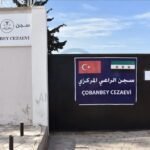
Al-Ra'i Prison is one of the most prominent irregular...